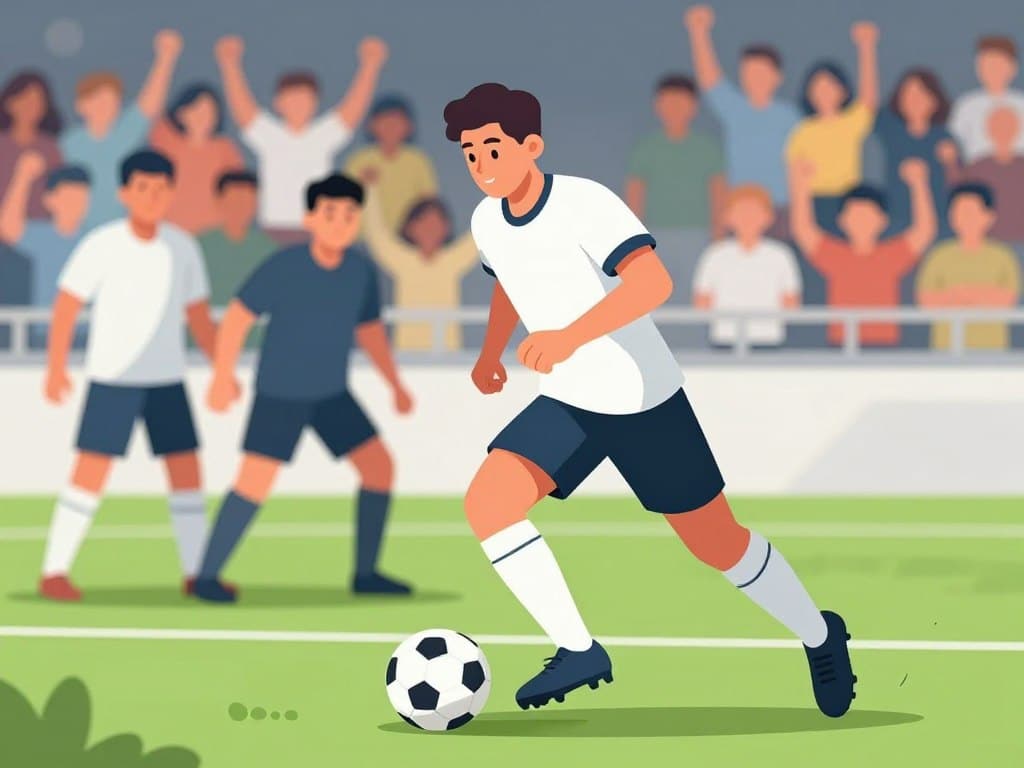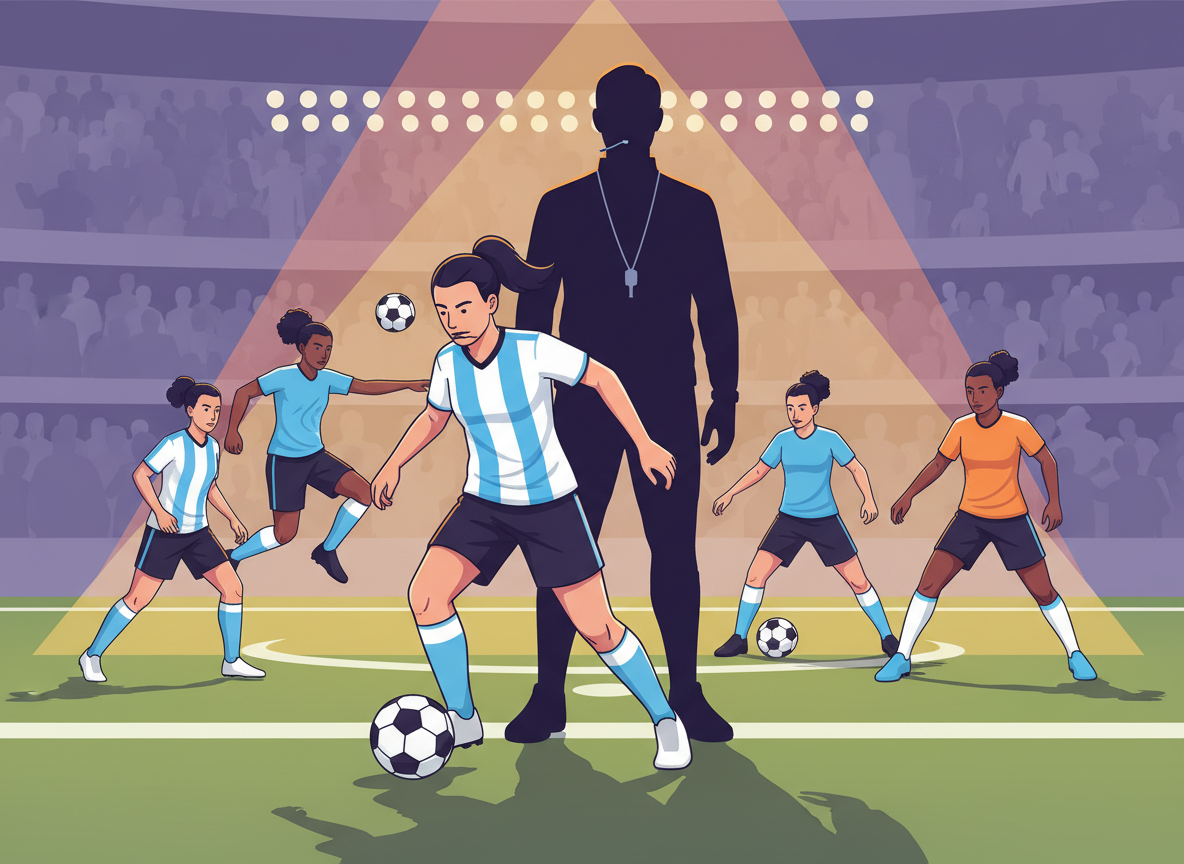

I still remember the match where everything changed: I had the ball on my foot, a defender bearing down, and my head went blank. That split second of doubt pulled me out of flow and cost us a clear chance.
What I call overcoming fear of mistakes in soccer isn’t about getting careless. It’s about getting decisive again when the pressure rises. I shifted from worrying about outcomes to asking one simple question: “What’s the best next touch?”
In this short guide I’ll give straight tools you can use in the next practice and the next game — not slogans or vague pep talks. Expect practical drills, quick in-game resets, and ways to spot when worry is costing you options.
Soccer is messy: crowds, coaches, team talk, and a brain wired to predict the worst. I’ll show how a present-moment mindset restores confidence and improves performance on the pitch.
Key Takeaways
- Fear can freeze your instincts; simple actions return flow.
- Shift from outcome thinking to one-step focus to boost confidence.
- Use quick in-game resets to recover after an error or near-miss.
- Practice drills that simulate pressure, not just isolated skills.
- Team language and culture shape how players handle small errors.
When fear shows up in your game and what it costs you
There are matches where the ball starts to feel heavier and choices get smaller. That pressure nudges you toward safety: the square pass, the conservative touch, the disappear-after-a-turnover move.
How fear turns you into a “safe” player
As a player I chose the easy option more often: no dribble, no through ball, just avoid blame. That shift shrinks your menu of options and kills chances you used to create.
The mental loop: judgment mode and future predicting
Judgment mode is the running voice that says, “I’m not good enough.” Future predicting adds, “Coach will sub me if I lose it.” Together they make the ball feel heavy and slow your decisions.
Why a little tension helps—but overthinking destroys flow
Some nerves sharpen focus and reaction. But when tight shoulders, shallow breathing, and rushed first touches take over, you stop reacting and start calculating. That ends flow—the effortless sequence when actions feel right and timed.
- Example: a midfielder receives under pressure — react (open, scan, play) or stall and invite trouble.
- In American youth football, loud sidelines and high standards make players read every error as failure.
- Simple fix: aim to react first, judge later; rebuild focus with one clear next action.
| Signal | What it costs | Quick fix |
|---|---|---|
| Tight shoulders | Slower touch | Three deep breaths |
| Rushed touch | Turnover | Soften first contact |
| Hiding after error | Lost confidence | Ask for the ball once |
What’s actually triggering your anxiety on the field
I watched a player freeze after one slip—then I realized the scene he feared was the real opponent. Pinpointing that scene is step one.
Pinpoint the moment
Ask yourself: which single mistake keeps replaying? A bad pass, a lost ball in midfield, a missed shot, or a whiffed clearance.
Pressure sources that hit hardest
Coaches who shout or sub you quickly shape future worry. Teammates can signal disappointment with looks or comments. Parents and the stands add weight with body language or heckling.
Kids and children pick up these cues fast; athletes feel them during every touch.
Questions to stop the spiral
- “What am I afraid will happen?”
- “Is that guaranteed?”
- “What one action can I control on the next play?”
- “If a teammate did this, what would I tell them?”
| Trigger | Sign | Immediate question |
|---|---|---|
| Bad pass | Stiff first touch | What one simple pass can I make now? |
| Shaming by coach | Looking to bench | Is sub definite or a reaction? What can I fix next minute? |
| Parent/stand reaction | Body language/sigh | Would I judge another player like this? |
Quick pivot: you can’t control sideline reactions, but you can change what a mistake means and how fast you respond.
Overcoming fear of mistakes in soccer by changing what “mistake” means
I began treating errors as data, not proof I didn’t belong. That shift turned every miss into a small lesson for better decisions and sharper skills.
Mistakes are supposed to happen: they are part of learning and growth. Trying a new pass or role will trip you up sometimes; that’s how your brain and body update.
Use four practical mistake categories
- Stretch: you tried a harder pass or new position; keep experimenting.
- A-ha: right idea, wrong option; replay the choice and keep the intent.
- Sloppy: lost focus or tired; fix scanning and body basics.
- High-stakes: costly errors; prioritize prevention and simple recovery plans.
Look for the message, not the blame
Ask: “What does this tell me?” A sloppy giveaway may mean fatigue, not character. That question gives one clear adjustment, fast.
| Mistake | Likely cause | One adjustment |
|---|---|---|
| Underhit pass | hips closed | open body earlier |
| Wrong through ball | poor scan | check shoulder before release |
| Careless turnover | low focus | reset with breath and simple pass |
Elite reality check: top players miss often—shots and penalties fail even for elite names. That shows misses are just part work, part learning, and part opportunity to get better.
In-game tools to play present, decisive, and confident under pressure
When the crowd tightens and the clock runs down, I use a few simple habits to keep my focus and protect performance.
Stop projecting outcomes. The moment I spot a thought like “If I lose it…” I label it projection and shift to one clear next action. That rule snaps me out of future traps and back into the way the ball moves now.
One-touch simplicity. Not literally one-touch every time, but one-touch thinking: scan, decide, execute—then release. It keeps my mind on the next pass and not the last play.
10-second reset. After an error I do one breath, a quick scan, a loud cue to myself (“Next play”), and immediate re-engagement. It stops a slip from becoming a run of poor choices.
Goal-focused self-talk: “Play through the lines,” “Win the next duel,” or “Find the winger early.” These lines build confidence and reduce fear making the moment smaller.
Bold, not safe. Take risks that match your role: a through ball when your striker checks, a dribble when cover exists. Smart risks create opportunities for your team; safe play often invites pressure.
| Moment | Tool | Result |
|---|---|---|
| Missed shot | Reframe + counterpress | Recover possession |
| Bad pass | Sprint recovery + earlier scan | Limit turnover impact |
| Nutmeg | Body reset + timed tackle | Regain balance and role |
Build a training and team environment where mistakes don’t feel dangerous
Culture wins before tactics: the way a team treats errors shapes every touch and pass. If mistakes feel dangerous—shame, sarcasm, or instant benching—kids and children will play safe instead of creative.
Coaches: don’t shame—create psychological safety
Set a clear rule: no public blame. Swap criticism for a short question: replace “What are you doing?” with “What did you see?” That simple change keeps players thinking, not shrinking.
Coach modeling: show the fix, not just the fault
Admit your own misread in training. Say, “That drill missed space; next time we’ll shift the cone.” When a coach models mistakes and adjustments, athletes learn the process without panic.
Parents: post-game language that builds effort and learning
Try this car-ride script: “What did you learn today?” Praise specific effort—attempting a through ball or taking on a defender—then ask one small tweak. Kids respond to steady support; it lowers fear and builds confidence.
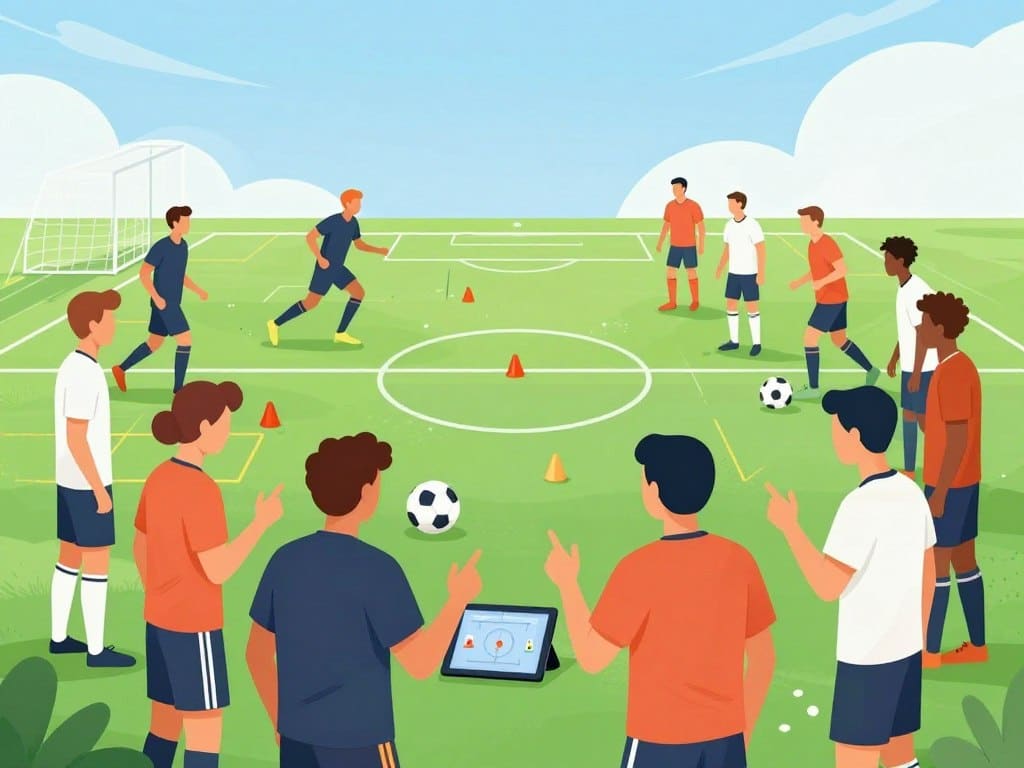
Design practice with permission to fail
- Use small-sided games with bonus points for risky passes.
- Run short drills that reward attempts, then coach the decision—don’t single out the miss.
- Encourage teammates to keep passing to a player after an error.
| Role | Behavior to use | Quick phrase |
|---|---|---|
| Coach | Model errors and adjustments | “Good try—what’s the next touch?” |
| Parents | Reward effort and learning | “Tell me one brave play you made.” |
| Team | Maintain connection after turnovers | “Keep showing; we want you on the ball.” |
Why this matters: groups that treat failure as data help athletes learn faster and play freer. Treat psychology like staff—Sam Allardyce did that at Crystal Palace—and you protect performance, not soften it. For more on building that mindset, see building mental toughness.
Conclusion
The moment I stopped chasing spotless play, my decisions became faster and truer. I learned that worry is not proof you’re weak; it often means you care. With a simple mindset shift, that energy stops stealing time and starts helping choices.
In games, do three things right away: stop projecting outcomes, pick one clear next action, and treat the last error as information—not a sentence. Those moves get players back in the flow and protect confidence under pressure.
Why it matters: soccer is fast and messy. The best teams accept mistakes as part of growth and keep risk alive so skills and creativity can show up.
Next week plan: one training drill that forces a stretch and lets you fail, one short self-talk line for pressure (“Next play”), and one post-game question: “What did I learn?” I tried this, my choices simplified, my skills surfaced more often, and I felt like myself on the ball again.