
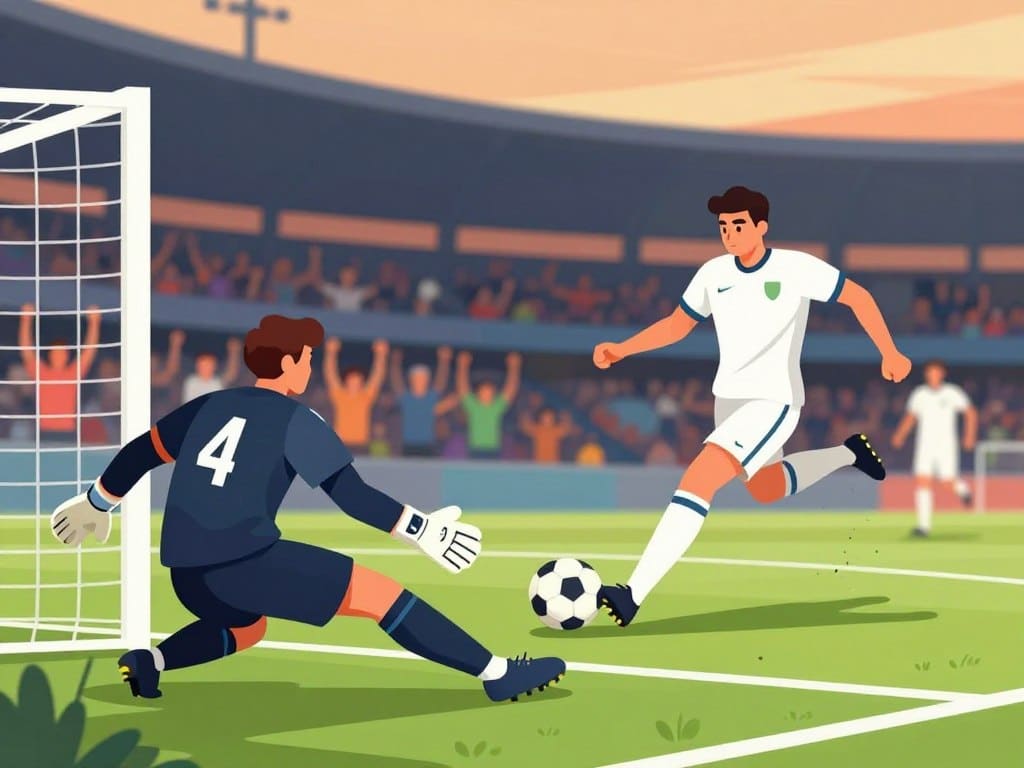
Have you ever stood on a run-up and felt the whole world watch your next move?
I remember a night at a youth cup where a single kick turned a season into a story I still tell; those moments feel personal in a way normal play rarely does.
Here I’ll show you what truly matters for success: routine, attention control, and training design. This guide treats a penalty as a skill under pressure, not pure luck.
Expect practical tools: a pre-kick routine you can copy, a stress-practice protocol, and clear game-day decision rules that cut errors.
This helps players, coaches, goalkeepers, and parents across U.S. youth leagues and adult football. I’ll focus on three levers we’ll build: regulate your body, narrow your mind, and train under stress so game day feels familiar.
Key Takeaways
- Learn a repeatable pre-kick routine to steady your body and mind.
- Use attention cues that narrow focus to the right targets.
- Practice with controlled stress so match moments feel familiar.
- Apply simple game-day rules to reduce rushed decisions.
- See penalties as trainable skills, supported by mental work and technique.
Why penalty shootouts feel different: what pressure does to your mind and body
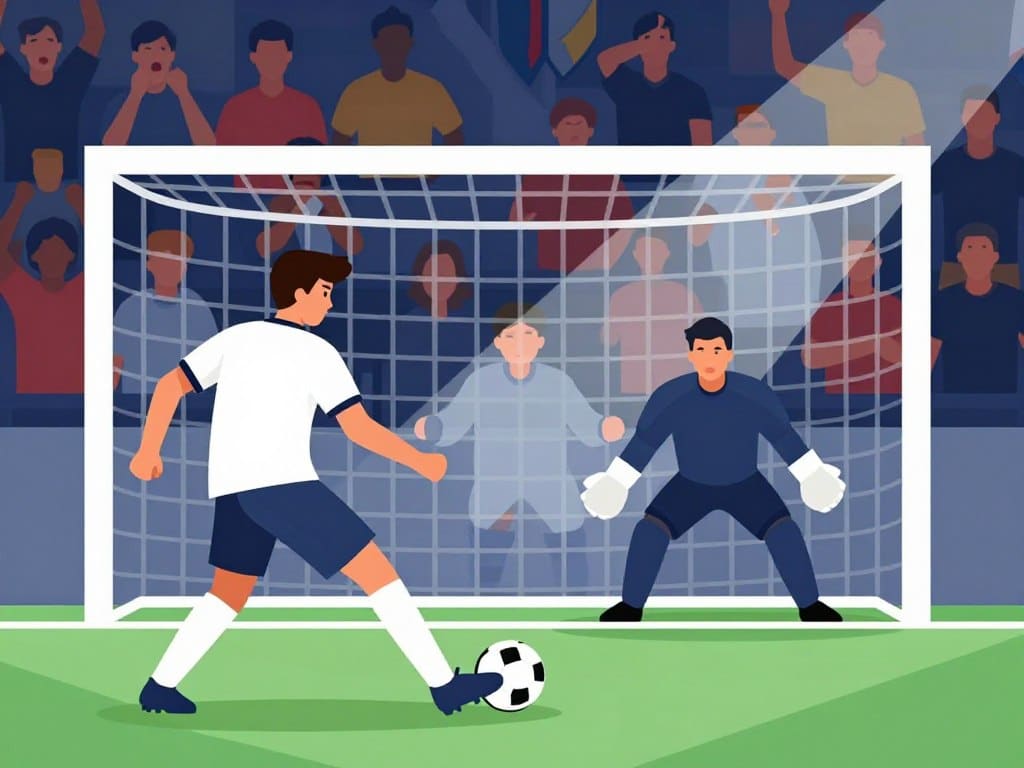
That final walk from the halfway line feels smaller and louder than any other ten yards on the pitch.
Every step highlights isolation: you, the ball, and a simple task that suddenly matters more than the rest of the match. A single penalty can feel like it defines you; that feeling changes how you move and think.
Optimal arousal and the Yerkes-Dodson curve
Think of arousal like volume. Too low and you go casual; too high and your touch tightens. The Yerkes-Dodson idea says there’s a sweet spot where a player’s ability peaks. Match the volume to your skill and the kick stays natural.
Body signals that disrupt technique
Under stress the sympathetic nervous system floods you with adrenaline and cortisol. Heart rate and breathing spike, shoulders creep up, and small muscles lose finesse.
Attentional tunneling and missed cues
Stress narrows vision; you might not notice the keeper’s late lean or your plant foot angle. That “I didn’t see it” moment is real, not excuse.
Choking: distraction vs self-focus
Choking can come two ways: distraction (outcome worries or crowd noise steal attention) or self-focus (you overthink mechanics and break automatic motion). Quick self-check: are your thoughts about the score, or about micro-fixing your ankle?
- Quick fix idea: if physiology and attention are changing the kick, your plan must calm both the body and the mind—not just tweak technique.
Handling pressure in penalty shootouts with a repeatable pre-kick routine
A quiet few seconds before the kick can change how your legs and mind line up. I use that pause to make the moment feel routine, not sudden.
Why a short routine helps: Jordet & Hartman (2008) found longer, consistent pre-kick rituals linked to higher success at big tournaments. A steady pattern slows heart rate and narrows thoughts. It buys you time to commit without rushing.
- Place the ball. Breathe: one firm inhale to expand the ribs, then a longer exhale to lower tension.
- Pick a spot on the goal and say a cue word (example: “smooth” or “corner”). Keep it one word.
- Fix a soft gaze on your target, not the goalkeeper, then take your measured run-up and strike.
Use a short visualization: hear the crowd, feel turf under studs, sense the ball’s weight, see the ball hit your target. Reframe the moment as a challenge: “show my best strike,” not “don’t miss.”
| Routine Step | Action | Why it works |
|---|---|---|
| Setup | Place ball, check spot | Reduces last-second doubts |
| Reset | Breath: inhale/exhale | Calms body and legs |
| Commit | Cue word + gaze | Prevents overthinking and leaks to goalkeeper |
Quick checklist: rehearse this routine in practice, copy the steps into your notes app, and use it when you take penalty efforts in matches. For deeper mental work, see my piece on build mental toughness.
Train for the moment, not just the kick: pressure-proof penalty practice that transfers
Train like the moment will be loud, slow, and watched—because that’s exactly what a penalty shootout feels like. Below I share a plug-and-play protocol and simple drills you can run with teams this week.
Match-like protocol: why and how
Why: Research shows stress widens shot dispersion and raises breathing and cognitive anxiety.
How: Walk from halfway, play crowd noise, rank attempts, record video, enforce small targets, then finish with a round where the goalkeeper knows the placement.
Drills that transfer
- Small targets (cones or taped squares) to tighten grouping under stress.
- Team competition with limited lives or light conditioning as consequences.
- Mid-session rule switches (must place, must drive, different run-up tempo) to remove comfort.
| Step | Constraint | Why it works |
|---|---|---|
| Halfway walk | Walk in alone | Recreates match isolation |
| Enforced targets | Tape squares | Tightens dispersion |
| “Keeper knows” | Goalie informed | Trains mind-game response |
Finish with a weekly plan: 6–10 high-quality, high-stakes reps per player, not hundreds of casual kicks. Profile each player: do they get distracted or over-focus? Use that profile to tailor reps.
Game-day execution: smart decisions on penalty kicks when everything is on the line
When the stadium hums and the whistle hangs, clear choices beat creativity. I give three tight options you can pick from and rules you can use right away.
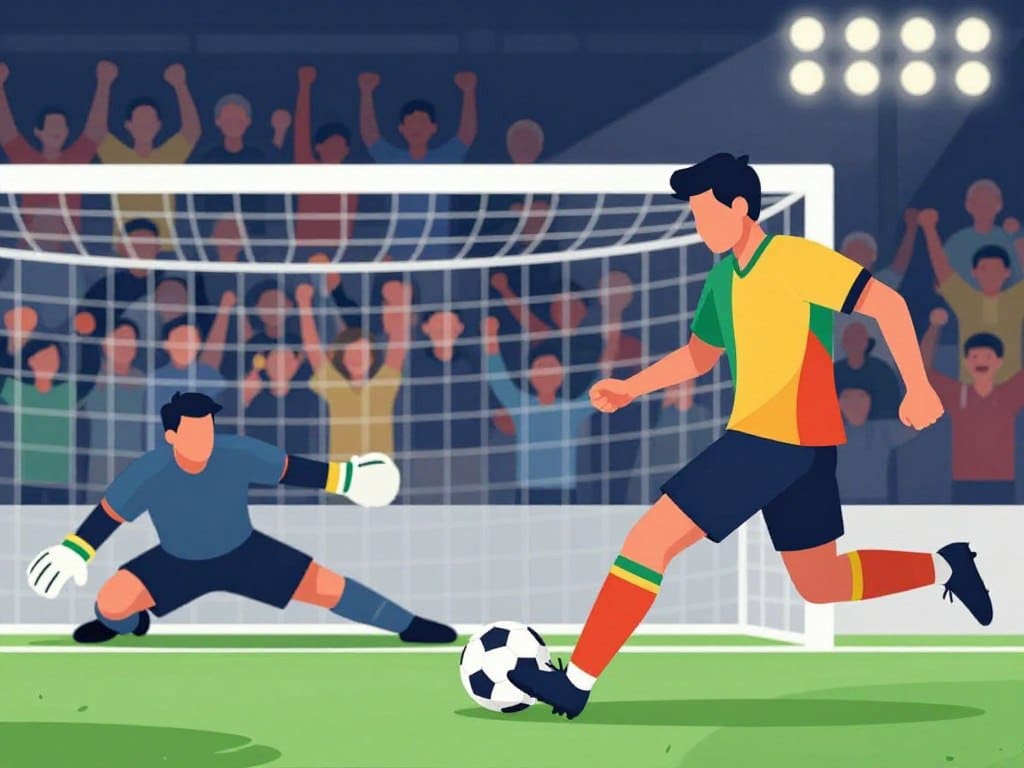
Pick your approach: power, placement, or disguise
Rule of thumb: use the option that matches your usual success. If you score most with placement, place. If you score with pace, hit with power. If you mix shoots, choose disguise only if you practice it under stress.
Timing and routine: use the whistle and run-up
Start your pre-kick routine before you move. Let the referee whistle mark your trigger; rushing is a choice, not an accident. Shorten your steps if noise spikes; keep the same cue word and commit on the last exhale.
Numbers that matter
Match penalties average about 85% conversion; shootout rates fall to roughly 74–76%. High-leverage, “must score” kicks can dip under 60%, while some game-winning attempts jump near 92%.
- Coach’s quick decision tree: early takers = consistent scorers; middle = adaptable players; anchor = calm finisher.
- Choose order to build momentum; research shows the team that kicks first wins more often.
- Example: in a youth final, pick your confident placer to go first, your power taker third, and your calm anchor last.
| Role | Best slot | Why |
|---|---|---|
| Consistent placer | 1–2 | Builds early success and confidence |
| Power taker | 3–4 | Maintains momentum; pressure shifts later |
| Calm anchor | 5 or last | Handles high-leverage closing kicks |
Beat the psychological battle with the goalkeeper and the crowd
You can feel the keeper trying to shrink the goal before you step up. That move is part psychology, part theater; keepers often act like they have nothing to lose and that vibe can nudge a taker toward doubt.
How keepers use distraction and visual dominance
Goalkeepers use delays, sudden movements, and direct eye contact to pull attention off your strike. These tactics create doubt by inviting you to watch them instead of your routine.
What to focus on instead of the keeper
Lock onto controllables: breath, plant foot, contact point, and your chosen corner. Use one purposeful glance at the keeper, then return to your target.
Goalkeeper prep that raises save odds
For goalkeepers, good guessing mixes pattern study and cue-reading: hips, run-up tempo, and body shape give real hints about direction and height.
- Players: protect the next penalty taker with calm body language after any result.
- Keepers: read cues early, commit decisively, then sell the dive to influence the taker’s mind.
- Both sides: no tactic guarantees a goal or a save; the smart attention plan improves your odds when noise is loudest.
| Role | Key Action | Why it helps |
|---|---|---|
| Taker | One glance, then lock to contact point | Keeps mind on what you control |
| Keeper | Read hips/run-up, commit early | Converts cues into a decisive move |
| Team | Calm celebration or reset | Protects the next penalty taker’s focus |
Conclusion
One steady breath before a shot often separates a practiced player from a nervous one. The core idea: a penalty is a short stress test of attention, breathing, and commitment, not just a kick.
Three transferable tools: a repeatable pre-kick routine, pressure-rep practice designed to mimic match stress, and simple game-day decisions that keep your team focused.
Keep the science simple: manage arousal so your technique stays automatic and your mind stays on useful cues. Jordet & Hartman and later research back that routine and targeted preparation raise success odds.
Next session: pick one routine, run a pressure protocol, log outcomes, and adapt to each player’s choke pattern. Remind teammates to react calmly after every attempt—how they respond matters more than most think.
Quick checklist: routine chosen, pressure reps done, results tracked, and team reset plan ready. Do that and the next shootout will feel like practice—on purpose.