
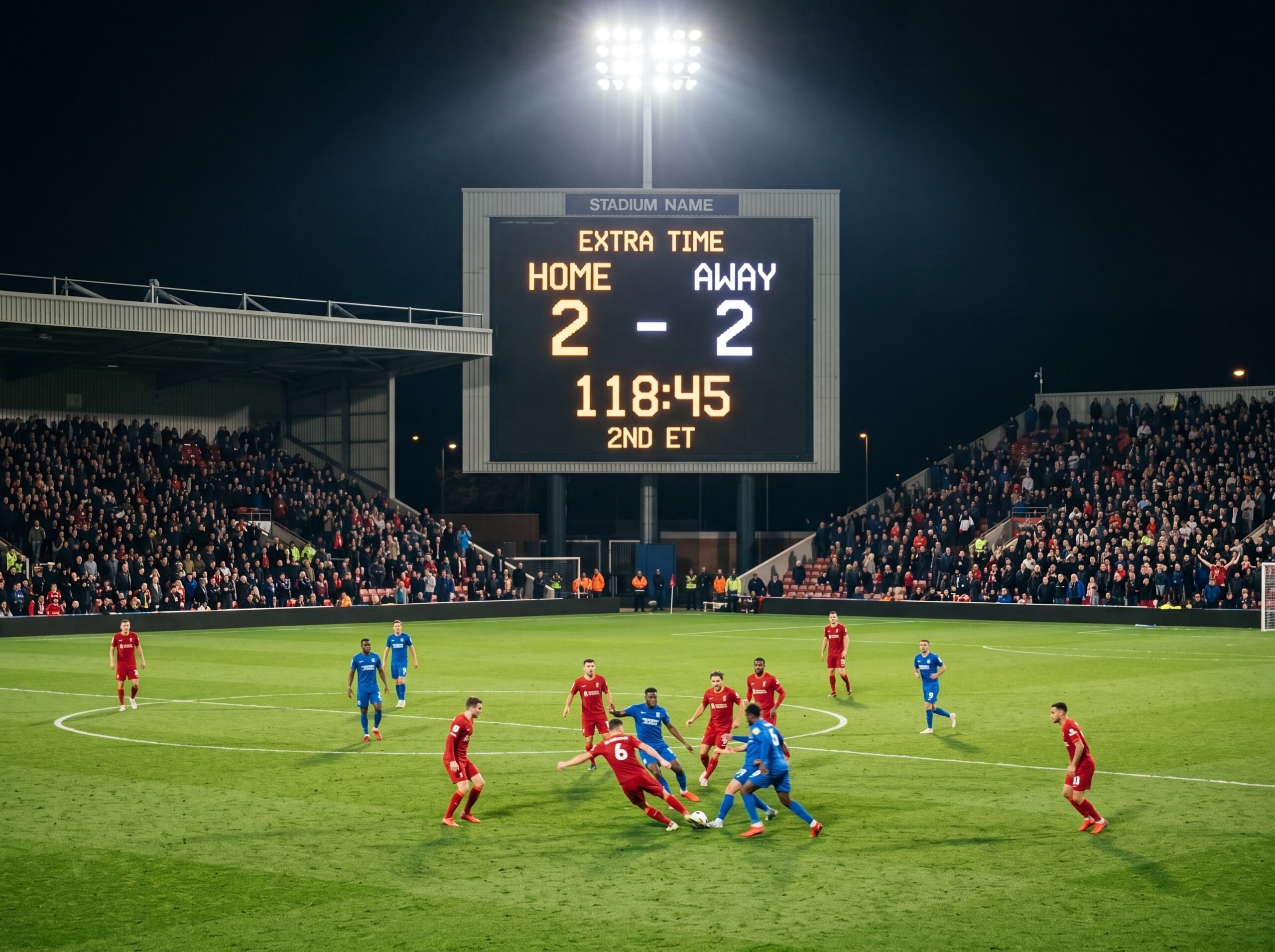
Extra time in soccer is two 15-minute halves, 30 minutes in total, played when a knockout match is still level after 90 minutes. Both halves are always played in full, unlike American overtime, which often ends the moment someone scores. If the teams are still tied after extra time, the match goes to a penalty shootout. Extra time only happens in knockout games where one team has to advance. League matches that finish level simply end in a draw.
That is the short answer. This guide goes deeper: how extra time differs from stoppage time, how the referee actually calculates added minutes, what happens in the shootout that can follow, the history of formats like the golden goal, and how all of it plays out at the World Cup and the Champions League.
Two things people mean by “extra time”
Before going further, it helps to clear up a mix-up, because people use this phrase in two different ways.
The first meaning, and the correct one in proper soccer terms, is the 30-minute period in knockout matches described above. That is what most of this guide is about.
The second meaning is casual. Many fans, especially in the US, say “extra time” when they really mean the few minutes the referee adds at the end of each half for stoppages. In soccer that is called stoppage time, added time, or injury time, and it is a different thing entirely. It happens in every match, even a 0-0 league game, and it does not break a tie.
So if you came here wondering why the referee showed “5 minutes” at the end of a half, you want stoppage time, covered in the next section. If you came here about the 30-minute period that decides tied knockout games, that is extra time in the strict sense, covered after it. This guide explains both in full.
Stoppage time vs extra time vs penalties at a glance

These three get mixed up constantly. Here is the difference in one place.
| Term | Also called | When it happens | How long |
|---|---|---|---|
| Stoppage time | Added time, injury time | At the end of each half, in every match | A few minutes, set by the referee |
| Extra time | Overtime (US) | After 90 minutes in a tied knockout match | Two 15-minute halves, 30 minutes total |
| Penalty shootout | Penalties, spot kicks | After extra time if still level | Until one team wins |
The simplest way to remember it: stoppage time is added to a half, extra time is added to the match, and penalties settle it if extra time cannot.
Stoppage time explained
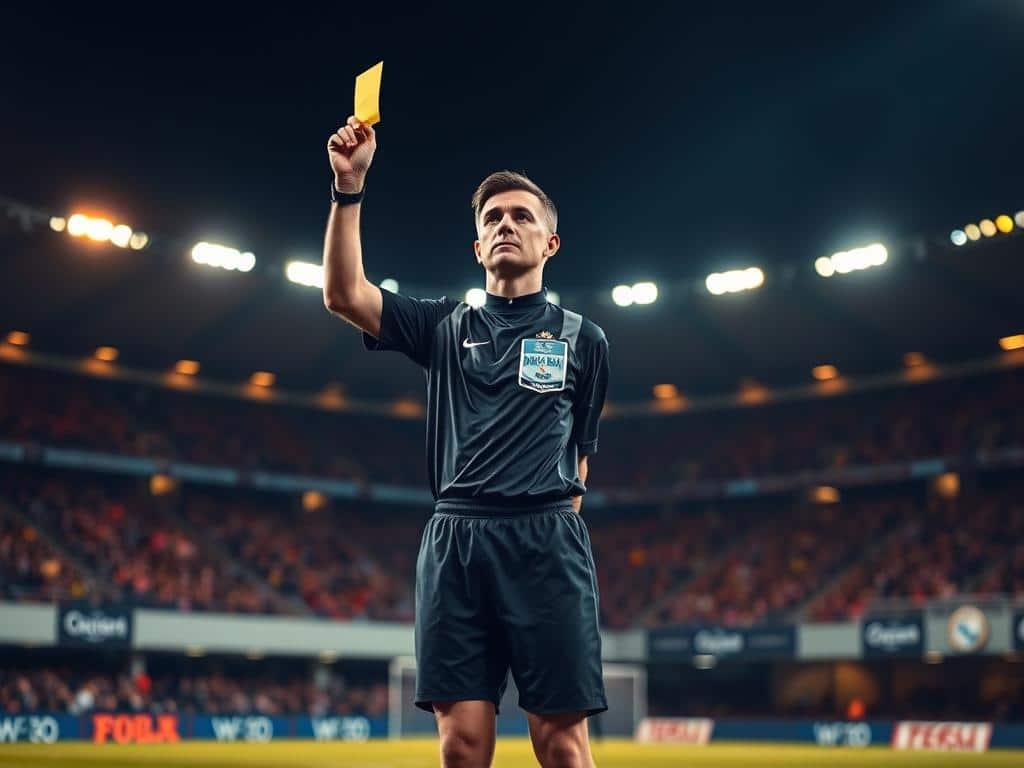
Stoppage time is the extra minutes the referee adds to the end of each half to make up for time the ball was not in play. Soccer’s clock never stops, so when play pauses for an injury, a substitution, a goal celebration, a VAR check, or deliberate time-wasting, those seconds are tracked and handed back at the end of the half.
A few things people often get wrong about it:
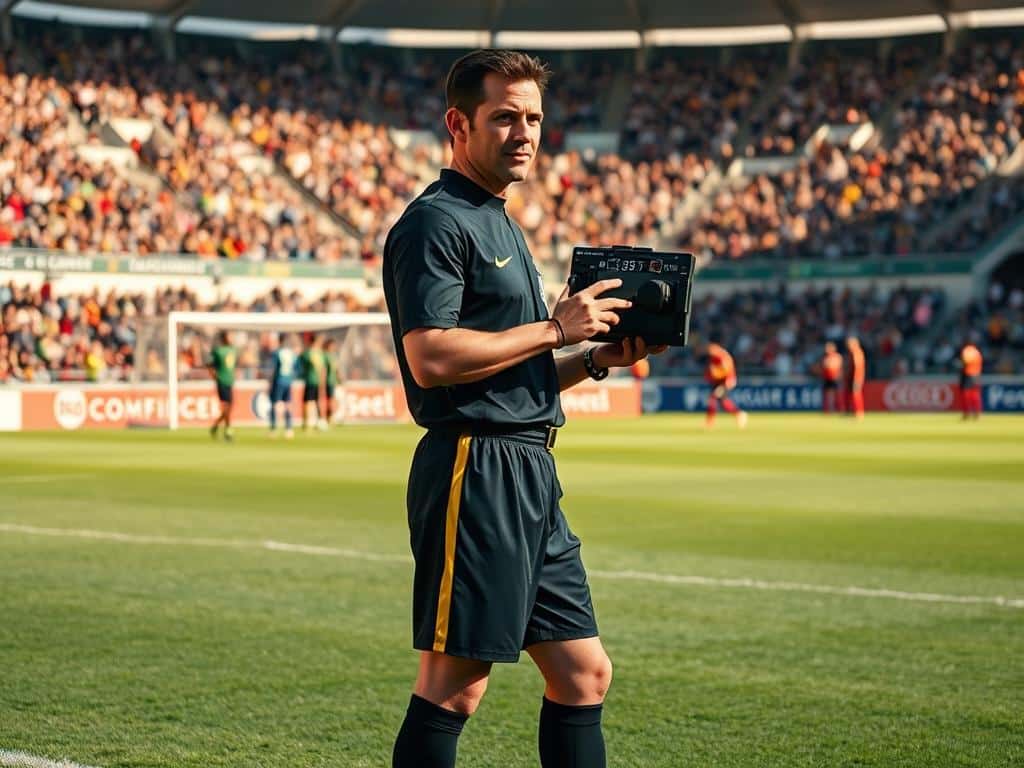
- The fourth official’s board shows a minimum, not a maximum. When the board reads “+4”, the referee will play at least four more minutes, and can add more if there are further stoppages during that time.
- It is set by the referee, not the clock. There is no fixed amount. A clean half might add one minute, a chaotic one much more.
- It applies to every match. Even a game that will end in a draw has stoppage time. It has nothing to do with breaking a tie.
Stoppage time used to be short and loosely counted, often just two or three minutes. That changed at the 2022 World Cup, when FIFA told referees to account strictly for every delay, including long goal celebrations and VAR reviews. The result was striking. Several matches saw more than 10 minutes added to a single half, and some passed 14 minutes, far beyond what fans were used to. The approach has since influenced how added time is counted across the game.
Extra time explained
Extra time is the extra 30 minutes played to break a tie in a knockout match. It runs as two 15-minute halves with a short break between them, and the referee manages it exactly like the first two halves. Teams change ends for the second period.
It is only used when a competition needs a winner. In the group stage of a tournament, or in most league games, a draw after 90 minutes is a normal result and the match ends there. Once a tournament reaches its knockout rounds, two tied teams cannot both advance, so extra time decides it.
Two details worth knowing:
- Both halves are always completed. A goal in the first minute does not end the match. This is the key difference from sudden-death formats and from overtime in many US sports, where the first score can finish things instantly. In soccer, the full 30 minutes are played.
- Teams get an extra substitution. Squads are allowed one additional substitution in extra time on top of their normal allocation, which lets managers bring on fresh legs for the final push.
If you grew up on American sports, “overtime” is your word for this. It maps onto extra time, with the difference that soccer plays both halves out rather than stopping on the first goal.
After extra time: the penalty shootout
If the score is still level after the full 30 minutes, the match goes to a penalty shootout. It works like this:
- A coin toss decides which goal is used and which team shoots first.
- Each team takes five penalties, alternating, each from a different player.
- Whoever has scored more after five kicks wins. If the result is mathematically settled early, the shootout stops there.
- If the teams are level after five each, it goes to sudden death, one kick each per round, until one team scores and the other misses. Every outfield player and the goalkeeper must take a kick before anyone goes again.
A short history of the shootout
The shootout is newer than people assume. Before 1970, drawn knockout ties were settled by replays or, worse, by a coin toss or a drawing of lots. Italy reached the Euro 1968 final on a literal coin flip after a goalless semi-final, which made the lack of a fair tiebreaker impossible to ignore.
IFAB, the game’s law-making body, adopted the penalty shootout in 1970. It reached the World Cup finals in 1982, when West Germany beat France in a semi-final, and it decided a World Cup final for the first time in 1994, when Brazil beat Italy after Roberto Baggio skied the last kick.
One experiment is worth knowing. Because the team shooting first wins around 60 percent of the time, IFAB trialed an “ABBA” order from 2017, where teams took kicks in the pattern used by tennis tiebreaks to remove that advantage. It was tested in lower-level competitions, including the FA Community Shield, but feedback was mixed and it was dropped in 2018. The traditional alternating order remains.
Golden goal and silver goal: the formats that came and went
Extra time has not always been played in full. For about a decade either side of 2000, two sudden-death style rules were tried, then abandoned.
The golden goal arrived in the mid-1990s to encourage attacking play. The first team to score in extra time won instantly, and the match stopped on the spot. Germany won Euro 1996 with one, and David Trezeguet scored a golden goal to win Euro 2000 for France against Italy. The intention was to reduce cautious play, but it often did the reverse, because teams became so afraid of conceding the single goal that would end everything that they played even safer. IFAB scrapped it in 2004.
The silver goal was a brief compromise. Rather than ending the match instantly, a team leading at the end of the first 15-minute period of extra time would win, so play at least reached a natural break. Greece used it to reach the Euro 2004 final, beating the Czech Republic. It was abandoned at the same time as the golden goal.
Both are now history. The game settled on the full 30 minutes followed by penalties, which is what you see today.
Extra time at the World Cup and Champions League
The biggest knockout competitions all use the same structure: 30 minutes of extra time, then penalties if needed.
At the 2026 World Cup, this matters from the Round of 32 onward, the knockout stage that begins on June 28. Every group-stage match can end in a draw, but once the brackets start, any tie after 90 minutes goes to extra time, and any tie after that goes to penalties. The Champions League works the same way in its knockout rounds, where a tie that finishes level is settled by extra time and, if necessary, a shootout.
Famous matches decided in or after extra time
Some of the sport’s most remembered moments came in these extra phases.
The 2014 World Cup final is the cleanest example of extra time itself deciding a match. Germany and Argentina were goalless after 90 minutes, and Mario Gotze settled it with a superb finish in the 113th minute.

The 2005 Champions League final is often misremembered, so it is worth getting right. Liverpool’s famous comeback from 3-0 down against AC Milan happened in normal time, not extra time. The match then went through a scoreless extra time and was finally won on penalties. It is a perfect illustration of how one game can pass through all three phases: stoppage time, extra time, and penalties.
The 2022 World Cup final showed the full sequence too. Argentina and France finished 3-3 after the complete 30 minutes of extra time, with Kylian Mbappe scoring a hat-trick, before Argentina won the shootout to give Lionel Messi the title.
How teams adjust their tactics in extra time
Extra time is as much about management as fitness. With players tired after 90 minutes, managers often use that extra substitution for fresh legs, sometimes holding one back specifically for this period, and may change shape to either protect a likely shootout or chase a winner.
Players also pace themselves differently. The first 90 minutes reward endurance, while extra time demands short bursts and clear heads, since one lapse can end a season. At the 2018 World Cup, Croatia played extra time in three straight knockout matches on their run to the final, a brutal schedule that showed how deeply the period tests a squad.
FAQ
How long is extra time in soccer?
Extra time is 30 minutes, split into two 15-minute halves with a short break between them. Both halves are always played in full.
Is extra time the same as stoppage time?
No. Stoppage time is the few minutes added to the end of each half in every match to cover lost time. Extra time is a separate 30-minute period played only in tied knockout matches.
Does “extra time” mean the minutes added at the end of a half?
A lot of people use it that way, but strictly it does not. Those minutes are stoppage time, also called added time or injury time, and they happen in every match. Extra time, properly, is the 30-minute period played only in tied knockout games.
Is extra time the same as overtime?
Yes, overtime is the American word for extra time. The difference is that soccer plays both 15-minute halves in full, rather than ending as soon as a team scores.
When does a soccer match go to extra time?
Only in knockout matches that are level after 90 minutes, where one team must advance. Group-stage and most league matches that finish level simply end in a draw.
What happens if extra time ends in a draw?
The match goes to a penalty shootout. Each team takes five penalties, and if still level, it continues into sudden death until there is a winner.
Why does the fourth official’s board sometimes show fewer minutes than get played?
Because the board shows the minimum added time. The referee plays at least that long and can add more if there are further stoppages during it.
What were the golden goal and silver goal?
They were sudden-death style extra time rules used between the mid-1990s and 2004. The golden goal ended the match on the first extra-time goal, and the silver goal ended it if a team led after the first 15-minute period. Both were scrapped in favour of the full 30 minutes plus penalties.
Does the World Cup use extra time?
Yes. In the knockout stage, a tie after 90 minutes goes to 30 minutes of extra time, then a penalty shootout if still level. In 2026 this applies from the Round of 32 onward.