
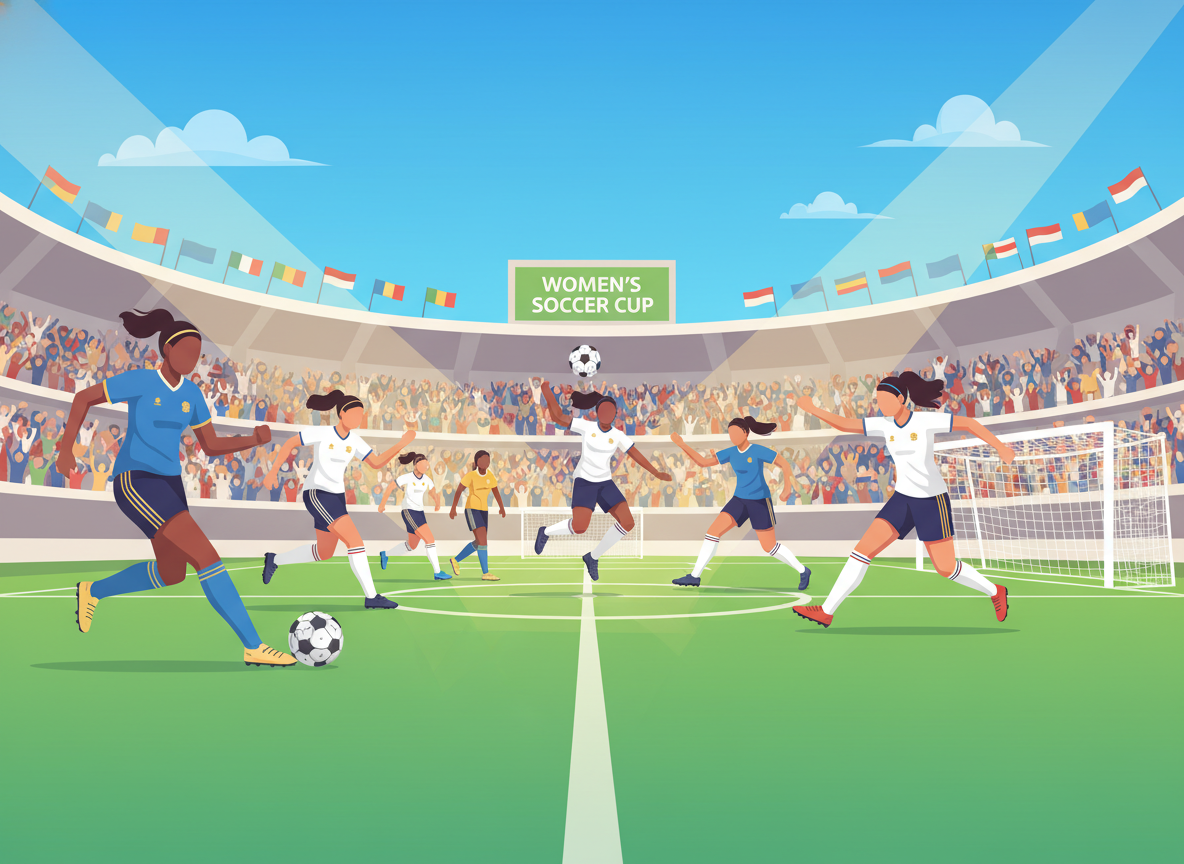
Exploring the women’s soccer world cup history feels like uncovering a hidden treasure chest filled with drama and defiance. I have spent years digging through dusty archives to understand how this global sport truly evolved. You might think you know the story, but the early days of this soccer journey were quite wild.
The first official FIFA tournament kicked off in 1991 with only twelve teams. Since then, the game has exploded, reaching thirty-two nations in 2023 and planning for forty-eight by 2031. This growth shows how much the globe has embraced the skill and passion of these athletes.
Five national teams have claimed the top prize, with the United States holding a record four titles. It is fascinating information when you realize that football was once banned in many countries. Every match of the beautiful game today stands on the shoulders of pioneers who played football for the love of the craft.
From surprising attendance records to shifting rules, the path to the world stage was never easy. Let’s look at some shocking facts that changed football forever. You might discover that the legends you cheer for today had to fight for the right to even step on the pitch.
Key Takeaways
- The first official FIFA sanctioned tournament began in China in 1991.
- The United States dominates the records with four total championship titles.
- The 2023 edition was the first to be co-hosted and held in the Southern Hemisphere.
- Participation has grown from 12 teams in the beginning to 32 teams today.
- Future plans include an expansion to a 48-team format by 2031.
- Only five nations have ever won the prestigious trophy in its history.
1. The First Women’s World Cup Wasn’t Official FIFA
Here’s something that might shock you: the first women world cup happened in 1970, and FIFA had absolutely nothing to do with it. I find it fascinating that while the official records start later, the passion for the game was already exploding decades ago. These early pioneers proved that women belonged on the pitch long before the governing bodies of football took notice.
Denmark’s Victory in Italy 1970
In 1970, Denmark lifted the trophy in Italy, signaling a new era for international football. Just one year later, they did it again in Mexico, silencing a massive crowd at the legendary Azteca Stadium. They defeated the hosts 3-0 in a final that showed the world exactly what female athletes could achieve even without official support.
The Mundialito Era of the 1980s
During the 1980s, a series of competitions called the “Mundialito” or “Little World Cup” kept the competitive fire burning. Italy hosted four editions of this unofficial tournament, where both England and Italy claimed two titles each. It is incredible to think this high-level soccer was happening while major organizations stayed on the sidelines for years. This era of soccer proved there was a hungry, global audience waiting for a sanctioned stage.
| Year | Host Country | Champion | Significant Fact |
|---|---|---|---|
| 1970 | Italy | Denmark | First unofficial global meet |
| 1971 | Mexico | Denmark | 110,000 fans at the final |
| 1988 | China | Norway | Official FIFA pilot program |
FIFA’s 1988 Invitation Tournament Test Run
Everything changed when Ellen Wille pushed for more recognition after successful continental events in Asia and Europe. FIFA finally launched an invitation event in 1988 in China to test the waters for a global world cup. The opening match between China and Canada drew 45,000 people, proving the audience was ready for the beautiful game.
I have watched footage of that 1988 final where Norway defeated Sweden 1-0 in a tense, professional match. The success of those games convinced the organizers that a permanent fixture was necessary. On June 30, 1990, FIFA officially approved the creation of the first sanctioned world cup.
This recognition was a long time coming for the sport. It was built on the grit of players who played for the love of football when no one was looking. Those early, “unofficial” matches are the true foundation of the massive spectacle we enjoy today.
2. The United States Dominates Unlike Any Other Nation
Nothing compares to the absolute reign the United States has held over international football since the very first tournament. I have always found their consistency staggering, as they have set the standard of football for every other nation to follow. When you think about pure power in the sport, this is the first group that comes to mind.
Four Championship Titles Across Three Decades
The united states won the trophy in 1991, 1999, 2015, and 2019. These four stars on their jerseys represent decades of elite talent from dedicated players. Michelle Akers scored twice in the 1991 final to secure the first title for the states.
Carli Lloyd’s hat-trick in 2015 showed how unstoppable the winners can be. They are the only four-time cup winners in history. This makes them the most successful women world cup program ever.
Consecutive Finals Streak from 2011 to 2019
From 2011 to 2019, the American soccer squad reached three straight championship appearances. They faced Japan twice and the Netherlands once, proving they were the most dominant team. This sustained excellence defines a true dynasty in global football.
You can see how much they love to play when the pressure is high. Even during a 2011 penalty shootout loss, their resolve never wavered. This era proved the united states was the powerhouse everyone measured themselves against.
Eight Top-Four Finishes in Nine Tournaments
Their record of reaching the semifinals in eight straight world cup editions is truly jaw-dropping. No other teams in the history of the game match that level of consistency. They remained the best in soccer and always dangerous until the 2023 tournament.
While the 2023 world cup saw them exit early, their legacy remains unmatched. They have the most medals and top-four finishes of any nation. For thirty years, they were the gold standard for excellence on the world stage.
| Country | World Cup Titles | Top-Four Finishes | Finals Reached |
|---|---|---|---|
| United States | 4 | 8 | 5 |
| Germany | 2 | 4 | 3 |
| Norway | 1 | 4 | 2 |
| Japan | 1 | 1 | 2 |
3. The Women’s Trophy Is Worth a Fraction of the Men’s
Wait until you hear about the massive price gap between the two major trophies. I have stood close to these awards at exhibitions, and the craftsmanship is stunning on both. However, the material value reveals a lot about how the sport views gender equity today.
$30,000 vs. $150,000 Material Value Difference
The women world trophy is worth about $30,000 in raw materials. Meanwhile, the men world cup trophy clocks in at roughly $150,000. This five-fold difference happens because the men have a prize made of solid 18-karat gold.
The ladies’ prize uses sterling silver clad in 23-karat yellow and white gold. It is a striking disparity for a football tournament that generates billions of dollars. This information serves as a reminder of the distance left to travel toward true equality.
Every Champion Receives Their Own Trophy to Keep
There is a literal silver lining for the winners of the world cup. Every championship team receives their own authentic cup to keep permanently in their trophy cabinet. This is a massive perk compared to other premier football events.
In the men’s game, there is only one original trophy retained by FIFA. Winners there only get a replica to take home. When a team achieves their ultimate goal on the pitch, owning the real hardware is a special honor.
The Trophy Design and Symbolism
William Sawaya designed the current football hardware in 1998 for the 1999 tournament. It features a gorgeous spiral band that wraps around a soccer ball at the top. This elegant piece stands 47 cm tall and weighs about 4.6 kg.
Sawaya & Moroni sculpted the piece in Milan with great detail. In the 2010s, FIFA added a cone-shaped base where they engrave the winners’ names. It represents the growing history of soccer across the world and the pursuit of the next world cup while enclosing the ball at its peak.
| Feature | Women’s Trophy | Men’s Trophy |
|---|---|---|
| Primary Material | Sterling Silver & Gold Clad | Solid 18-Karat Gold |
| Estimated Material Value | $30,000 | $150,000 |
| Height | 47 cm (19 in) | 36.8 cm (14.5 in) |
| Permanent Ownership | Team keeps original winner’s trophy | Team receives a gold-plated replica |
4. A Single Match Drew Over 90,000 Fans to the Rose Bowl
Imagine standing among 90,185 screaming fans in the Rose Bowl on a sweltering July day in 1999. I still get chills thinking about that massive sea of faces. This event proved that the united states was ready to embrace elite women’s football on a grand scale.
The tournament drew over 1.2 million total people across all matches. It averaged 37,944 attendees per match. You could feel the culture shifting as fans flocked to see a high-stakes soccer game.
The 1999 Final Between USA and China
The atmosphere felt electric as the home team faced off against China. After a grueling battle with zero goals through regulation and extra time, this final went to penalty kicks. The tension was thick enough to cut with a knife!
The Americans eventually won the shootout 5-4. The explosion of noise from the crowd was unlike anything I have ever heard. It showed the world how much fans love to watch women play.
Brandi Chastain’s Jersey-Removal Celebration
When Brandi Chastain buried the winning penalty to clinch the women world cup, she did something unforgettable. She ripped off her jersey and dropped to her knees in pure joy. That moment became an iconic image of athletic triumph.
Some critics were surprised by her reaction, but I think it captured the raw emotion of the game perfectly. It proved that women’s football players possess the same fire as any athlete. This world cup victory changed how people viewed the sport forever.
American Television Viewership Records
The impact of 1999 paved the way for future success. By the time 2015 arrived, the world cup fever had reached new heights across the states. That year’s championship became the most-watched soccer match in American history.
Nearly 23 million viewers tuned in to watch the Americans beat Japan. This was more than the NBA Finals or Stanley Cup that same year! From the Rose Bowl to the ticker-tape parade in new york, fans now prioritize women’s football as a premier sport.
| Tournament Year | Venue Location | Attendance Figure | TV Viewership (USA) |
|---|---|---|---|
| 1999 Final | Rose Bowl, Pasadena | 90,185 | 17.9 Million |
| 2015 Final | BC Place, Vancouver | 53,341 | 23 Million |
| 1991 Final | Tianhe Stadium, Guangzhou | 63,000 | Minimal |
5. The Tournament Went Global in Unexpected Ways
The boundaries of women’s soccer are breaking down fast. I have watched this tournament grow from a small 12-team event and truly change the game.
It now fills huge stadiums on many continents. This expansion highlights soccers impact on the modern world by giving players a massive stage.
First Southern Hemisphere and Two-Nation Co-Hosting in 2023
The 2023 edition was a major milestone for fans. Australia and New Zealand became the first co-hosts, bringing the women world to the Southern Hemisphere.
This event was the first fifa women world competition held across two different confederations. Taking the game to a new place like Sydney energized fans in a brand-new time zone.
| Edition Year | Host Region | Key Milestone |
|---|---|---|
| 2023 | Oceania | First Cross-Confederation Hosting |
| 2027 | South America | First Brazilian Championship |
| 2031 | North America | Expanded to 48 Teams |
Spain’s Historic Championship Victory
Spain’s 1-0 win over England was a massive moment for football history. This year was the first time they claimed the title after years of hard work.
Spain became only the second nation to win both the men’s and women’s world cup. It is a feat that proves their talent belongs at the top of the world.
Brazil Bringing the Cup to South America in 2027
The fifa women world journey heads to Brazil in 2027. This will be a historic moment since it is the first South American host.
Looking further ahead, the 2031 competition will feature 48 teams across four nations. Whether you watch on a mobile device or in person, the growth of the women world is clear.
This soccer evolution keeps the world cup at the center of the sporting world. Every football match finds a special place in history. I love seeing this football culture spread so widely.
6. Women’s Soccer World Cup History Shows Explosive Growth
If you think the growth of women’s football is just a trend, these explosive numbers will definitely change your mind. Over the years, the tournament has transformed from a small event into a massive global spectacle.
This isn’t just about more players hitting the pitch. It is about a sport finally getting the attention it deserves on every digital device in your home.
From 12 Teams in 1991 to 48 Teams by 2031
The expansion of the women world cup field is nothing short of incredible. In 1991, only 12 teams took the pitch in China. By 1999, the field grew to 16, followed by 24 in 2015 and 32 in 2023.
Starting in 2031, the number of teams will jump to 48. This shows that FIFA finally recognizes the massive depth of talent in the women world today.
Revenue Growth and Broadcasting Rights Battles
Finances provide critical information about the game’s health. This information shows that FIFA took the bold step of separating broadcasting rights in 2023. Previously, they were always bundled with the men’s world cup.
Networks were forced to value the women independently for the first time. Even though some major broadcasters offered less than 5% of what they pay for men’s rights, the 2023 tournament still managed to generate $570 million.
The $570 Million 2023 Tournament
While $570 million is a massive win, it represents only 9% of the revenue from the 2018 men’s world cup. Despite this gap, attendance tells a story of unprecedented demand for the sport across the globe.
- Record Attendance: 1,978,274 total fans attended matches in 2023.
- Average Crowds: Matches averaged 30,911 fans per game.
- Global Reach: Over 750 million viewers watched the 2015 tournament.
| Tournament Year | Participating Teams | Total Attendance |
|---|---|---|
| 1991 China | 12 Teams | 510,000 |
| 2015 Canada | 24 Teams | 1,353,506 |
| 2023 Australia/NZ | 32 Teams | 1,978,274 |
When you take into account that the 2015 final was a record-breaking football event, the potential is clear. People around the world are watching this football cup more than ever before. It is a great time for football in the women world.
7. Asia and Europe Broke Through Male-Dominated Barriers
I’ve always found it fascinating how certain nations rose to the top when the world least expected it. You see, while the united states often dominates the conversation, the real magic of the women world cup happens when new giants emerge.
The women world stage shifted significantly when teams from Asia and Europe proved they could out-hustle anyone on the football pitch. Whether you were watching from a pub in Tokyo or a living room in new york, these moments felt like a revolution in sport.
Japan’s 2011 Earthquake-Year Triumph
In 2011, a small but mighty team from Japan did something no Asian nation—men or women—had ever done before. Just months after a horrific earthquake and tsunami, these players lifted the spirits of their world. They won the 2011 world cup by facing heavy odds.
They beat the Americans in a thrilling final on penalties after a 2-2 draw. It showed that sport can heal people and change the game forever. Their resilience remains a benchmark for international football excellence.
Germany’s Back-to-Back Championships in 2003 and 2007
Germany remains the only other nation to be repeat world cup winners. They showed amazing football skills and tactical discipline to win in both 2003 and 2007. They proved they were the best by defeating Sweden and then Brazil.
By defeating Brazil 2-0 in the 2007 fifa women world event, they proved European dominance was here to stay. Legends like Birgit Prinz helped these winners set a high bar for how women should play. Their technical football prowess was truly ahead of its time.
Norway’s 1995 Victory Over Germany
Before Germany reigned, Norway took their place in history. They won the 1995 world cup by beating Germany 2-0 in Sweden. This fifa women victory proved that any dedicated team could reach the top with the right infrastructure.
Even though Brazil’s Marta holds the record for most goals, these European and Asian squads are the true world cup winners who shattered barriers. I saw fans in the states cheering for this evolution of the global game as well. These players knew how to play in the right place at the right time.
Many women world athletes now follow the path these pioneers paved for the fifa women community. Their legacy continues to inspire millions of fans across every continent.
| Tournament Year | Cup Winner | Runner-up | Final Score |
|---|---|---|---|
| 1995 | Norway | Germany | 2-0 |
| 2003 | Germany | Sweden | 2-1 |
| 2007 | Germany | Brazil | 2-0 |
| 2011 | Japan | United States | 2-2 (3-1 PK) |
Conclusion
These seven facts reveal how women world cups evolved into billion-dollar spectacles. This sport shifted from Denmark’s unofficial win to Spain’s global victory in a very short time. When nations invest in schools and football infrastructure, elite players emerge to play on the biggest stage.
The value gap between men world events and women world cups proves that policy changes are a vital goal. We need strong policy to ensure four women from every confederation can eventually compete for the cup. Favorable odds follow teams that prioritize the ball and an inclusive policy each year.
Watching the tournament on your device connects you to this soccer story. As fifa women‘s events grow to 48 teams, the world popular game reaches every place. Future world cups will shatter odds as people and schools take this information into account.
| Growth Category | Historical Information |
|---|---|
| Tournament Policy | Improving odds for women through football in schools |
| World Popular Reach | Comparing champions league metrics to women world cups |
| Ball Mastery | How four women‘s confederations mastered the ball to play in finals |
| Men World Parity | Using information to account for odds and update policy |